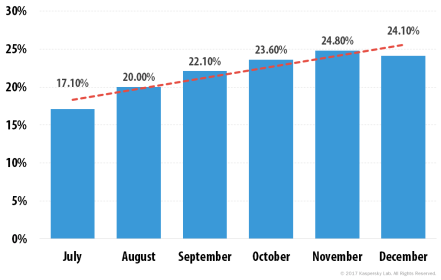
Interesting charts here with 2017 predictions of industrial ethernet marketshare – http://www.profibus.com/uploads/media/pxddamkey%5B17892%5D_IE-Book.pdf

Interesting charts here with 2017 predictions of industrial ethernet marketshare – http://www.profibus.com/uploads/media/pxddamkey%5B17892%5D_IE-Book.pdf

Mirror of https://github.com/nebgnahz/awesome-iot-hacks :
A curated list of hacks in IoT space so that researchers and industrial products can address the security vulnerabilities (hopefully).
Software Defined Networking seeks to centralize control of a large network. The abstractions around computer networking evolved from the connecting nodes via switches, to applications that run on top with the OSI model, to the controllers that manage the network. The controller abstraction was relatively weak – this had been the domain of telcos and ISPs, and as the networks of software intensive companies like Google approached the size of telco networks, they moved to reinvent the controller stack. Traffic engineering and security which were done in disparate regions were attempted to be centralized in order to better achieve economies of scale. Google adopted openflow for this, developed by Nicira, which was soon after acquired by VMWare; Cisco internal discussions concluded that such a centralization wave would reduce Cisco revenues in half, so they spun out Insieme networks for SDN capabilities and quickly acquired it back. This has morphed into the APIC offering.
The centralization wave is a bit at odds with the security and resilience of networks because of their inherent distributed and heterogenous nature. Distributed systems provide availability, part of the security CIA triad, and for many systems availability trumps security. The centralized controllers would become attractive targets for compromise. This is despite the intention of SDN, as envisioned by Nicira founder M. Casado, to have security as its cornerstone as described here. Casado’s problem statement is interesting: “We don’t have a ubiquitous and horizontal security layer that provides both context and isolation. Where do we normally put security controls? We put it in one of two places. We might put it in the physical infrastructure, which is great because you have isolation. If I have ACLs [access control lists] or a firewall or an IDS [intrusion detection system], I put it in a separate box and I put it away from the applications so that the attack surface is pretty small and it’s totally isolated… you have isolation, but you have no context. .. Another place we put security is in the end host, an application or operating system. This suffers from the opposite problem. You have all the context that you need — applications, users, the data being accessed — but you have absolutely no isolation.” The centralization imperative comes from the need to isolate and minimize the trusted computing base.
In the short term, there may be some advantage to be gained by complexity reduction through centralized administration, but the recommendation of dumb switches that respond to a tightly controlled central brain, go against the tenets of compartmentalization of risk and if such networks are put into practice widely they can result in failures that are catastrophic instead of isolated.
What the goal should be is a distributed system which is also responsive.
On Nov 25, a hacker going by “andy saolis” infected the San Francisco Municipal Transportation Agency’s (SMFTA) network with ransomware that encrypted data on 900 office computers, spreading through the system’s Windows operating system. Saolis threatened to publish 30 gigabytes of data, including contracts, employee data, customer information. SMFTA’s ticketing system was shut down to prevent the malware from spreading. The attacker demanded a 100 Bitcoin ransom, around $73,000, to unlock the affected files. Salted hash reported the malware is likely a variant of HDDCryptor, which uses commercial tools to encrypt hard drives and network shares.
The service was restored due to backups . However consider these systems were in an ICS scenario. An unexpected downtime would result, which would be unacceptable.
Cgroups limit how much you can do. Namespaces limit how much you can see.
Linux containers are based on cgroups and namespaces and can be privileged or unprivileged. A privileged container is one without the “User Namespace” implying it has direct visibility into all users of the underlying host. The User Namespace allows remapping the user identities in the container so even if the process thinks it is running as root, it is not.
Using cgroups to limit fork bombs from Jessie’s talk:
$ sudo su # echo 2 > /sys/fs/cgroup/pids/parent/pids.max # echo $$ > /sys/fs/cgroup/pids/parent/cgroups.procs // put current pid # cat /sys/fs/cgroup/pids/parent/pids.current 2 # (echo "foobar" | cat ) bash: for retry: No child processes
Link to the 122 page paper on linux containers security here. Includes this quote on linux kernel attacks.
“Kernel vulnerabilities can take various forms, from information leaks and Denial of Service (DoS) risks to privilege escalation and arbitrary code execution. Of the roughly 400 Linux system calls, a number have contained privilege escalation vulnerabilities, as recently as of 2016 with keyctl(2). Over the years this included, but is not limited to: futex(2), vmsplice(2), mremap(2), unmap(2), do_brk(2), splice(2), and modify_ldt(2). In addition to system calls, old or obscure networking code including but not limited
to SCTP, IPX, ATM, AppleTalk, X.25, DECNet, CANBUS, Econet and NETLINK has contributed to a great number of privilege escalation vulnerabilities through various use cases or socket options. Finally, the “perf” subsystem, used for performance monitoring, has historically contained a number of issues, such as perf_swevent_init (CVE-2013-2094).”
Which makes the case for seccomp, as containers both privileged and unprivileged can lead to bad things –
““Containers will always (by design) share the same kernel as the host. Therefore, any vulnerabilities in the kernel interface, unless the container is forbidden the use of that interface (i.e. using seccomp)”- LXC Security Documentation by Serge Hallyn, Canonical”
The paper has several links on restricting access, including grsecurity, SELinux, App Armor and firejail. A brief comparison of the first three is here. SELinux has a powerful access control mechanism – it attaches labels to all files, processes and objects; however it is complex and often people end up making things too permissive, instead of taking advantage of available controls. AppArmor works by labeling files by pathname and applying policies to the pathname – it is recommended with SUSE/OpenSUSE, not CentOS. Grsecurity policies are described here, its ACLs support process–based resource restrictions, including memory/cpu/files open, etc.
I think of bitcoin as a self-securing system. Value is created by solving the security problem of verifying the last block of bitcoin transactions. This verification serves as a decentralized stamp of approval, and the verification step consists of hashing a nonce and a block of transactions through a one way hash function and arriving at a checksum with a certain structure (which is hard because hash is random and meeting the structure requirement is a low probability event).
What happens if parties collude to get greater hashing power and increase their share of mining ? This is what happened with GPU mining farms on bitcoin. It was one of the motivations behind Ethereum, which enables code to run as part of transactions, and for the hashing algorithm to be not easily parallelized over a GPU. But it is not economical to mine on desktops as the motivation seems to suggest.
The important aspect I think is the self-securing idea – how can a set of computational systems be designed so that they are incentivized to cooperate and become more secure as a result of that cooperation.
At a recent blockchain conference, some interesting topics of discussion were zero knowledge proofs, consensus algorithms, greater network-member-ownership in a network with network-effects instead of a centralized rent collection, game theoretic system designs and various etherereum blockchain applications.
Update: this self securing self sustaining view is explored further here. https://medium.com/@jordanmmck/cryptocurrencies-as-abstract-lifeforms-9e35138d63ed
DYN is a DNS provider internet infrastructure company. It’s the name behind widely used DynDNS. It supports DNS for twitter, visa, github, mongo, netflix and several other big tech sites.
Doug Madory a researcher at DYN, presented a talk on DDoS attacks in Dallas at a meeting of the North American Network Operators Group (NANOG) 68 – his was the last talk on Oct 19, wednesday. The talk discussed the attack on Krebs on Security last month and details other such attacks.
On Friday several sites serviced by DYN were attacked in a distributed denial-of-service (DDoS) attack.
The distributed denial-of-service (DDoS) attack involved malicious DNS lookup requests from tens of millions of IP addresses including a botnet on a large number of IoT devices infected with the Mirai malware, which is designed to brute force security on any IoT device. There are cameras involved with fixed passwords that are burned into the firmware, that cannot be changed.
The implications of IoT devices that are 1) unsecure 2) impossible to secure and 3) infected by malware and 4) controlled by a botnet that is controlled by malicious intent are made clearer with this attack.
Update on DDOS mitigation: RFC 3882, Configuring BGP to block Denial-of-Service attacks, discusses Remote Triggered Black Hole (RTBH) method, to configure certain routers to selectively stop malicious high volume traffic which is targeting a particular IP. The target site is made inaccessible but the rest of the network service stays active. An example configuration is at https://networkengineering.stackexchange.com/questions/10857/use-bgp-to-defend-against-a-ddos-attack-originating-from-remote-as . The improvement is to reduce the side-effects of such a delisting, to enable faster recovery when the attack is over.
A recent talk discussed ethics for autonomous vehicles, as an optimization problem. There can be several imperatives for an AV which are all “correct”, yet be in conflict for an autonomous vehicle which relies on hard coded logic.
For example: Follow Traffic safety rules. Stick to the lane. Avoid obstacles. Save most human lives. Save passengers.
How can a vehicle prioritize these ? Instead of a case by case design, the proposal is to cast it in an ethics framework based on optimization of various ideals and constraints with weighted coefficients. Then test the outcomes.
The optimization equation looks to minimize ( path_tracking + steering + traffic_laws ) subject to constraints ( avoid_obstacles ). The equations produce different behaviour when the coefficients are changed.
Another consideration is the Vehicle intent: is it fully in control or can the human override it. This affects the software assumptions and system design.
The talk was presented by Sarah Thornton, PhD. Stanford. A related discussion on safety is here : Who gets the blame when driverless cars crash ?.
Somewhat related is the idea of computer vision itself operating correctly. There can be adversarial inputs as discussed in the paper Intriguing properties of neural networks which discusses blind spots. Generative Adversarial Models are a way to improve the generalization capabilities of a network by pitting generative against discriminative models. The European Conference on Computer Vision starts today: http://www.eccv2016.org/main-conference/
Nvidia just announced the Tesla P40 and P4 cards for Neural network inferencing applications. A review is at http://www.anandtech.com/show/10675/nvidia-announces-tesla-p40-tesla-p4. Comparing it to the Tesla P100 released earlier this year, the P40 is targeted to inferencing applications. Whereas the P100 was targeted to more demanding training phase of neural networks. P4o comes with the TensorRT (real time) library for fast inferencing (e.g. real time detection of objects).
Some of the best solutions of hard problems in machine learning come from neural networks, whether in computer vision, voice recognition, games such as Go and other domains. Nvidia and other hardware kits are accelerating AI applications with these releases.
What happens if the neural network draws a bad inference, in a critical AI application ? Bad inferences have been discussed in the literature, for example in the paper: Intriguing properties of neural networks.
There are ways to minimize bad inferences in the training phase, but not foolproof – in fact the paper above mentions that bad inferences are low probabalility yet dense.
Level 5 autonomous driving is where the vehicle can handle unknown terrain. Most current systems are targeting Level 2 or 3 autonomy. The Tesla Model S’ Autopilot is Level 2.
An answer is to pair it with a regular program that checks for certain safety constraints. This would make it safer, but this alone is likely insufficient either for achieving Level 5 operations, or for providing safely for them.
ISO 26262 is a standard for Automotive Electric/Electronic Systems safety, that is adopted by car manufacturers. Its V shape consists of two legs, the first comprising definition, analysis, design, architectural design, development and implementation. The second leg consists of verification and validation of the software, starting from unit tests to functional tests, safety tests and system-wide tests. Model based design is used to reduce the complexity. These models are now fairly complex. Model based design is the one of the value adds that Mentor Graphics automotive kit provides is help with achieving compliance with this standard.
ISO 26262 is derived from its parent, the IEC 61508 standard, which is titled Functional Safety of Electrical/Electronic/Programmable Electronic Safety-related Systems. This parent standard has variants for safety of automotive, railway, nuclear, manufacturing processes (refineries, petrochemical, chemical, pharmaceutical, pulp and paper, and power) and machinery related electrical control systems. An associated, upcoming standard is the SAE J2980.
An excellent talk today by MIT fellow Ricardo Dematos discussed more comprehensive approaches to automotive safety. This is building up from his work with safety research at MIT, AWS IoT and our SyncBrake entry for V2V safety at TechCrunch Disrupt 2015.
A key problem for embedded neural networks is reduction of size and power consumption.
The hardware on which the neural net runs on can be a dedicated chip, an FPGA, a GPU or a CPU. Each of these consumes about 10x the power of the previous choice. But in terms of upfront cost, the dedicated chip costs the highest, the CPU the lowest. An NVidia whitepaper compares GPU with CPU on speed and power consumption. (It discusses key neural networks like AlexNet. The AlexNet was a breakthrough in 2012 showing a neural network to be superior to other image recognition approaches by a wide margin).
Reducing the size of the neural network also reduces its power consumption. For NN size reduction, pruning of the weak connections in the net was proposed in “Learning both Weights and Connections for Efficient Neural Networks” by Song Han and team at NVidia and Stanford. This achieved a roughly 10x reduction in network size without loss of accuracy. Further work in “Deep Compression” achieved a 35x reduction.
Today I attended a talk on SqueezeNet by Forrest Iandola. His team at Berkeley modified (squeezed) the original architecture, then applied the Deep Compression technique above to achieve a 461x size reduction over the original, to 0.5Mb. This makes it feasible for mobile applications. This paper also references the V.Badrinarayan’s work on SegNet – a different NN architecture, discussed in a talk earlier this year.
The Nervana acquisition by Intel earlier this year was for a low power GPU like SOC chip with very high memory bandwidth.
Oracle MICROS Point of Sale systems are again reported to be attacked. The support site of MICROS was infected by malware which was able to access usernames and passwords and send them to a remote server. This remote server was identified as one previously known to be used by ‘Carbanak’, a cybercrime group.
ZDNet reports that in the last year, dozens of machines at Starwood and Hilton hotels were impacted by malware, with the aim of poaching payment and card data, which can be used or sold on to the highest bidder. The attack on MICROS systems may be behind these.
An advisory by VISA here, discusses two previous malware threats attacking POS systems, Carbanak and MalumPOS.
This report by Symantec describes POS attacks as multi-stage attacks, with threats and mitigation strategies.
In August 2014, Department of Homeland Security had issued an advisory for ‘Backoff’ a POS malware, which affected a large number of systems in retailers including Target, PF Chang’s, Neiman Marcus, Michaels, Sally Beauty Supply and Goodwill Industries International. PF Chang had a cyber insurance policy which covered direct damages, but not claims filed by Mastercard/Bank of America for credit card fraud reimbursements and reissuance via a “PCI DSS assessment”.
These trends are interesting for a few reasons. First, the recurrent attack are reason to accelerate the move to EMVs. Second, it gives rise to new architectures for payments. Third it draws attention to Blockchain technologies.
Verifone has a Secure Commerce Architecture which sends the payment data directly from the terminal system which receives the card, to the merchant (acquirer) bank, without touching the POS system (the windows computer handling invoicing). This reduces payment fraud and also makes certification for EMVs much easier.

EMV stands for Europay, Mastercard, Visa. After the EMV deadline of Oct 1, 2015, the liability for credit card fraud shifted to whichever party is the least EMV-compliant in a fraudulent transaction. Automated fuel dispensers have until 2017 to make the shift to EMV. ATMs face two fraud liability shift dates: MasterCard’s in October 2016 and Visa’s in October 2017.
Because of EMV securing the terminals, there is predicted to be a rise in online payments fraud. While counterfeit opportunity dwindles, the next top three types of credit card fraud, Account takeover, Card-not-present fraud, and (fake new) Application fraud are rising. The recent MICROS attack fits the pattern of attackers probing for and finding the weakest links in the payments chain.
A blackhat talk –https://www.blackhat.com/docs/us-14/materials/us-14-Zaichkowsky-Point-Of-Sale%20System-Architecture-And-Security.pdf
An ASN.1 vulnerability has been found in a security advisory of 7/18 here. It has to do with length bounds checking in the LTV triplet. A fix is provided but updating it on a large number of GSM devices is not practical. “It could be triggered remotely without any authentication in scenarios where the vulnerable code receives and processes ASN.1 encoded data from untrusted sources, these may include communications between mobile devices and telecommunication network infrastructure nodes, communications between nodes in a carrier’s network or across carrier boundaries, or communication between mutually untrusted endpoints in a data network.”
A discussion at Arstechnica here, brings up a real exploit against GSM base station software, that operates below the application layer and so can be exploited against a large number of devices.
A quote from the paper – “When GSM radio stacks were implemented, attacks against end devices were not much of a concern. Hence checks on messages arriving over the air interface were lax as long as the stack passed interoperability tests and certifications. Open-source solutions such as OpenBTS (Base Transceiver Station)allow anyone to run their own GSM network at a fraction of the cost of carrier-grade equipment, using a sim- ple and cheap software-defined radio. This development has made GSM security explorations possible for a significantly larger set of security researchers. Indeed, as the reader will see in the following, insufficient verification of input parameters transmitted over the air interface can lead to remotely exploitable memory corruptions in the baseband stack.”
The cellular baseband stack of most smartphones runs on a separate processor and is significantly less hardened, if at all. GSM does not provide mutual authentication, there is no protection against fake BTSs.
The primality testing idea for big numbers is to repeatedly check for a condition satisfied by primes, such as a^p mod p = a mod p, for different a, until a probabality bound is met.