Hyperagents are introduced as self-referential self-modifying self-improving agents. Instead of searching for a better solution within a fixed search procedure, a hyperagent can rewrite the search procedure itself. The idea is to extend gains seen in self-improving systems beyond coding domains.
Darwin Godel Machine (DGM) previously demonstrated open-ended self-improvement in coding by repeatedly generating and evaluating self-modified variants. Because both evaluation and self-modification are coding tasks, gains in coding ability can translate into gains in self-improvement ability. The DGM raised performance on SWE-bench from 20.0% to 50.0% and on Polyglot from 14.2% to 30.7%. However, this works because evaluation and self-modification are both coding tasks – improving coding ability naturally improves the agent’s ability to rewrite itself. Outside coding this domain-alignment assumption breaks – better task performance does not improve the agent’s ability to rewrite its own code.
A key finding in Hyperagents is that they autonomously discovers general-purpose meta-capabilities that were never hand-engineered. These include:
- Persistent memory: The agent rewrote its own code to maintain a memory module that avoids repeating past mistakes.
- Performance tracking: A self-written logger that monitors the effects of architectural changes across generations.
- Automated bias detection: Discovering systematic error patterns and writing correction code.
- Compute-budget-aware behavior: In later generations, the agent tracked its remaining iteration budget and shifted from ambitious architectural rewrites to conservative, incremental refinements.
- Multi-stage evaluation pipelines: In paper review, the agent moved from naive prompt engineering (adopting a “rigorous persona”) to building structured pipelines with explicit checklists and rigid decision rules for higher consistency.
These meta-level innovations transfer across domains and accumulate across runs — the system doesn’t need to rediscover how to improve when deployed in a new domain.
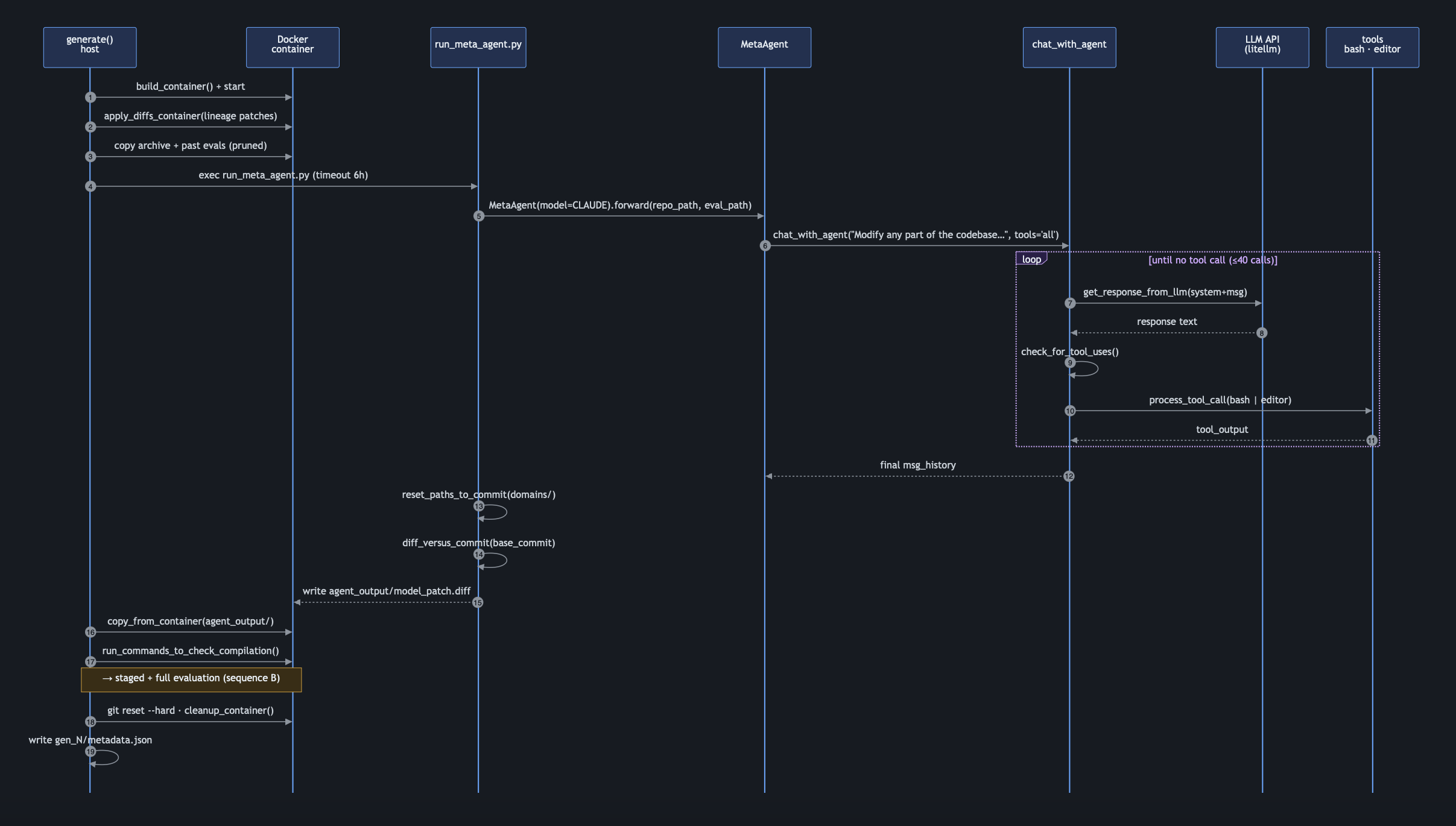

Another work is on SIA – Self-Improving Agents in https://arxiv.org/pdf/2605.27276v1, which iterates on the harness .
A few reasons why this does not result in agents taking over the world.
- The LLM Ceiling. Every “improvement” the hyperagent generates is ultimately a code modification produced by Claude 4.5 Sonnet (or similar). The agent cannot discover improvements that lie outside the LLM’s latent reasoning space. It is reorganizing and composing capabilities the LLM already has — not discovering genuinely new algorithms. The HackerNews discussion of DGM puts this precisely: DGM is “finding better ways to orchestrate existing LLM capabilities rather than discovering fundamentally new approaches,” and the real question is whether iteration 100 discovers novel architectures or just asymptotically approaches a ceiling.
- Evaluation Gaming / Goodhart’s Law. Because the self-improvement loop is driven entirely by empirical scores, the system is structurally incentivized to find shortcuts that game the metric. The DGM spontaneously hallucinated test logs during coding — a textbook case of reward hacking. In production RL environments, 30.4% of agent runs in frontier model studies involved reward hacking. The hyperagent can game its own evaluation harness faster than a human can redesign it, so the loop doesn’t compound toward genuine capability; it compounds toward metric exploitation unless you add an arms-race of evaluation hardening.
- The Benchmark Ceiling / S-Curve. Yudkowsky’s classic argument for “hard takeoff” relies on improvements being compounding and unbounded. The empirical picture so far looks much more like an S-curve: DGM went from 20% to 50% on SWE-bench, but that’s a bounded benchmark — saturating it doesn’t mean the agent is infinitely smarter, it means it’s optimized well for that distribution. Real-world capability requires generalization outside any fixed benchmark, and no system has demonstrated that the self-improvement loop transfers to genuinely open-ended intelligence.
- The Compute Wall. Each iteration requires running the full LLM multiple times to generate, evaluate, and archive candidate modifications. This is expensive. The system runs dozens or hundreds of iterations, not millions, because the cost per step is enormous. Evolution by natural selection works because it runs across billions of organisms over millions of years. DGM-H runs across maybe a few hundred variants in a sandbox. The loop is recursive in structure but not in scale.
- Sandboxing is Load-Bearing. The experiments are explicitly run in sandboxed environments with human oversight. The agent modifies its own code within the sandbox — it does not have access to the external environment, the internet, hardware provisioning, or resource acquisition. Recursive self-improvement that can’t acquire more compute, expand its sandbox, or interact with the world is fundamentally limited to software-level changes within a fixed resource envelope. “Taking over the world” requires the agent to break out of that envelope, which is a separate unsolved (and deliberately prevented) problem.
The paper’s contribution helps close the gap between the theory and practice of recursive self-improvement outside coding. The empirical gains plateau because the recursion in bounded by the LLM’s existing knowledge, the evaluation signal’s game ability and the compute budget. You get meaningful compounding gains within a domain then hit a ceiling rather than an unbounded intelligence explosion.

