Tag: machine learning

Neurosymbolic reasoning

Neurosymbolic reasoning combines two different kinds of computation. A neural network is a learned function, usually trained from data, that maps inputs into vectors and uses those vectors to predict useful outputs. It is good at pattern recognition, fuzzy matching, language, perception, and guessing promising next steps. A symbolic system is a system that manipulates explicit objects such as rules, formulas, programs, graphs, constraints, proofs, or search states. It is good at exactness: a proof step is valid or invalid; a SAT assignment satisfies a formula or it does not; a type checker accepts a program or rejects it.

A GNN, or graph neural network, is a neural network designed for data represented as graphs. A graph has nodes and edges. In SAT, for example, variables and clauses can be represented as nodes, and edges connect variables to the clauses in which they appear. This makes GNNs relevant because many formal problems are not naturally sequences of words; they are structured objects. Code has ASTs, control-flow graphs, and data-flow graphs. SAT formulas have variable-clause graphs. Theorems have dependency graphs of definitions and lemmas. A GNN can learn which parts of such a structure look important.

The core idea of neurosymbolic reasoning is simple: the neural part proposes, ranks, translates, or guides; the symbolic part represents, executes, constrains, or verifies. The neural system is allowed to be approximate because its output is not trusted directly. The symbolic system supplies the hard boundary between plausible and correct. In code, an LLM may propose a patch, but the compiler, tests, static analyzer, or verifier decide whether the patch is acceptable. In SAT, a neural model may suggest which variable to branch on, but the SAT solver performs exact search and a proof checker verifies the result. In theorem proving, a model may suggest a Lean tactic, but Lean checks whether the proof step is valid.

The reason this combination matters is that pure neural systems and pure symbolic systems have opposite strengths. Neural systems handle ambiguity and large messy inputs, but they can hallucinate or skip conditions. Symbolic systems are exact and compositional, but they often face enormous search spaces and require humans to formalize the problem precisely. Neurosymbolic reasoning is useful when a problem is both messy and exact: messy enough that learned guidance helps, but exact enough that unchecked guesses are dangerous.

Formal methods are a central use case because their hard part is usually not checking a finished proof. The hard part is finding the right specification, invariant, lemma, induction variable, proof tactic, or decomposition. A proof assistant can mechanically verify a proof, but it may not know which theorem to apply next. A SAT solver can prove unsatisfiability, but it may drown in bad branching choices. A verifier can check loop invariants, but someone must often invent those invariants. Neural networks help by searching this space of useful intermediate ideas.

SAT illustrates the division cleanly. For a satisfiable formula, the certificate is an assignment of truth values that makes every clause true. For an unsatisfiable formula, the certificate is a proof of contradiction, often in a format such as a resolution-style proof. A neural network can suggest a promising variable, a likely unsat core, or a useful learned clause. But the final answer must still be checked by a symbolic solver or proof checker. The neural model does not make SAT “true” or “false”; it helps navigate the search.

This does not mean neural SAT solvers are on a direct path to proving P = NP. P = NP would require a uniform polynomial-time method for solving every SAT instance in the worst case. Neural guidance can make many real instances dramatically easier, especially when they contain recurring structure from hardware, software, scheduling, planning, or verification problems. But worst-case SAT includes adversarial formulas designed to defeat heuristics. Better guidance can move the practical frontier without changing the worst-case complexity frontier.

The deeper promise is not that neural networks replace logic. The promise is that they make symbolic reasoning more usable. They can translate informal intent into candidate formal specifications, suggest missing invariants, rank lemmas, choose solver strategies, identify useful graph structure, and repair failed proof attempts. The symbolic system then checks whether these guesses actually satisfy the rules. This gives a division of labor: neural networks provide search intelligence; symbolic systems provide correctness.

There are two meanings of “neurosymbolic” that should be kept separate. The first is external neurosymbolic reasoning, where a neural model calls or guides explicit tools such as SAT solvers, proof assistants, compilers, planners, or databases. This is the practical and trustworthy version because the symbolic tool can reject invalid output. The second is internal symbolic representation, where researchers ask whether neural networks themselves learn vector representations that behave like variables, rules, types, objects, or relations. That is important for interpretability, but it is harder to trust because the “symbols” are implicit and distributed inside activations.

The main risk is not usually that the symbolic checker accepts an invalid proof. A good checker should catch that. The larger risk is proving or checking the wrong thing. A program can be verified against an incomplete specification. A sorter can be proved to return an ordered list while still dropping all input elements. A security function can be proved to require authentication while forgetting tenant isolation. Neurosymbolic systems therefore still depend on good specifications, not just good proof search.

Neural networks are useful for proposing promising moves in huge ambiguous spaces; symbolic systems are useful for exact manipulation and verification; neurosymbolic reasoning connects them by letting neural models guide search while symbolic tools enforce correctness; GNNs are relevant because many formal objects are graphs rather than plain text. The frontier is making formal reasoning scalable by wrapping exact checkers in learned search, translation, and repair loops.

Recent work has used graph neural networks to predict branching orders or guide branching decisions. One 2026 paper studies GNN-predicted initial branching orders for CDCL solvers, while earlier NeuroBack-style work plugged a neural heuristic into Kissat and reported solving more SAT Competition problems than the base solver on SATCOMP-2022 and SATCOMP-2023 sets.
Hessians and optimizers

The Hessian matrices—the second derivatives of the loss function with respect to weights have a pecular organization. For the past twenty years, researchers noticed that these massive matrices are almost entirely concentrated in blocks along the diagonal. This is like a filing cabinet where all the important stuff sits in labeled drawers and the drawers barely talk to each other.

A new paper by Dong, Zhang, Yao, and Sun offers an explaination of why this happens, and their answer is : it’s about the number of classes in your classification problem, not the math of cross-entropy loss as believed earlier. This carries practical consequences for how we train large language models.

Back in 2004, Ronan Collobert noticed something odd while analyzing neural network optimization. When he looked at the Hessian matrix—the landscape of curvature in your loss function—it had a block structure. The diagonal blocks (where parameters interact with themselves) were huge, but the off-diagonal blocks (where different parameter groups interact) were tiny. He proposed an explanation: the cross-entropy loss function creates this through a term called p(1p)p(1−p), which goes to zero as training progresses.

Here’s why it didn’t make sense, though nobody noticed: if cross-entropy loss was the culprit, why did the block structure show up before any training even happened? The network could be randomly initialized, weights completely random, and boom—already block-diagonal. You haven’t updated a single weight yet. Also, if you used a different loss function (like mean squared error), you still got block structure with multiple classes, so it wasn’t actually about cross-entropy at all.

The real story is more elegant: the block structure emerges directly from how many classes your problem has. With just two classes, forget it—no block structure. With a thousand classes, you get weak structure. With 32,000 classes like Llama 2’s vocabulary, you get basically perfect block-diagonal structure before you’ve even looked at your first data point.

How the Softmax Creates Block Structure (Even at Initialization)

Let’s walk you through the math, because once you see it, it clicks.

Imagine a linear classifier. You have weights VV (one row per class), input data xnxn, and you want to predict which of CC classes is correct. The softmax gives you:pn,c=exp(vcTxn)j=1Cexp(vjTxn)pn,c=∑j=1Cexp(vjTxn)exp(vcTxn)

This is a probability distribution—all the pn,cpn,c values sum to one. When weights are randomly initialized with standard initialization (like He or Xavier), something magical happens: because no class has seen any data yet, each class gets approximately equal probability. For 100 classes, pn,c1/100pn,c≈1/100 for each class. For 1,000 classes, pn,c1/1000pn,c≈1/1000. For 32,000 classes, pn,c1/32000pn,c≈1/32000.

Now here’s where it gets interesting. The loss function measures how badly you predicted the correct class:L=1Nn=1Nlogpn,ynL=−N1n=1∑Nlogpn,yn

To understand the shape of this loss—its curvature in different directions—you compute second derivatives. This is the Hessian.

When you compute the second derivative with respect to class ii‘s parameters, something different happens depending on whether you’re looking at the diagonal blocks (interactions of class ii with itself) versus off-diagonal blocks (interactions of class ii with class jj):

Diagonal blocks (class ii with itself):Hii=1Nn=1Npn,i(1pn,i)xnxnTHii=N1n=1∑Npn,i(1−pn,i)xnxnT

Notice the coefficient: pn,i(1pn,i)pn,i(1−pn,i). This has two parts. The first, pn,ipn,i, tells you how often we predict class ii. The second, (1pn,i)(1−pn,i), tells you how much “room” there is to change that prediction. When pn,i=1/Cpn,i=1/C, this product is approximately 1/C1/C.

Off-diagonal blocks (class ii interacting with class jj, where iji=j):Hij=1Nn=1Npn,ipn,jxnxnTHij=−N1n=1∑Npn,ipn,jxnxnT

Now the coefficient is pn,ipn,jpn,ipn,j—both probabilities multiplied together. When both equal 1/C1/C, this product is 1/C21/C2, which is much smaller than 1/C1/C.

This is the key: the same data term xnxnTxnxnT appears in both, but the coefficients differ. The diagonal gets a factor of 1/C1/C while the off-diagonals get 1/C21/C2. So when you measure the total size of each block using the Frobenius norm (which is like taking the square root of the sum of all squared entries):HijFHiiF1/C21/C=1CHiiFHijF≈1/C1/C2=C1

With C=100C=100, the off-diagonal is 1% the size of the diagonal. With C=32,000C=32,000, it’s 0.003% the size. The matrix is essentially block-diagonal.

But why does softmax create this difference? The answer is in the softmax derivative itself. When you change class ii‘s parameters, you don’t just change pn,ipn,i—you change all the probabilities, because they must sum to one. This coupling is where the p(1p)p(1−p) term comes from for the diagonal (the “self-coupling” of class ii), and the pqpq cross-term comes from for off-diagonals (how increasing one probability forces others down).

Why This Was Misunderstood for So Long

Collobert saw that cross-entropy had this special p(1p)p(1−p) term and thought “aha! That must be why.” But he missed two critical facts:

First, the p(1p)p(1−p) term appears in both the diagonal and off-diagonal parts of the Hessian—it’s not special to the diagonal. What’s special is that the ratio between them depends on CC, not on properties of the loss function.

Second, and this is the killer blow: Collobert only tested small numbers of classes. He’d use cross-entropy with multi-class problems (where he saw block structure) and compare to mean squared error with binary classification (where he didn’t). He was comparing apples to oranges—he was varying both the loss and the number of classes simultaneously, so of course he couldn’t figure out which one mattered. It turns out the number of classes is all that matters.

This is why the new paper’s insight is so satisfying. It reveals that you can take the simplest possible loss (just raw squared error), with the simplest architecture (linear!), and still get block-diagonal structure if CC is large. You don’t need any special properties of cross-entropy. You don’t need training to happen. You just need lots of classes.

Before Training Even Starts

This deserves emphasis because it’s genuinely counterintuitive: the Hessian at random initialization is already block-diagonal.

What does this mean in practice? Imagine you initialize a neural network for ImageNet (1,000 classes) with random weights. Before you’ve seen a single data point, before you’ve computed a single gradient, before you’ve updated a single weight: if you were to compute the Hessian matrix of your loss function at those random weights, it would be block-diagonal.

How? Well, the loss function is completely defined. You have a loss that depends on your current weights. The loss is high (your random network predicts garbage), but it’s defined. The second derivative of that loss with respect to your weights is well-defined too. And because of the softmax’s behavior with uniform probabilities, that Hessian has block structure.

This is what the paper means by the “static force”—a force that exists due to architecture, not due to training. The architecture says “we have 1,000 classes” and the softmax probabilites immediately become p1/1000p≈1/1000, and boom, block structure emerges.

Later, during training, another force emerges—the “dynamic force.” As the network learns, the probabilities become less uniform (maybe it’s very confident the image is a dog), and cross-layer interactions evolve. But by then, the block-diagonal foundation is already there.

What This Reveals About Optimizers

This discovery has concrete implications for how we optimize neural networks, especially large language models.

Modern LLMs like Llama 3 have vocabularies of 128,000 words. That’s 128,000 “classes” in a sense—your model needs to predict which word comes next. According to the theory, this means the Hessian is extraordinarily block-diagonal. In fact, with C=128,000C=128,000, the off-diagonal blocks are literally 1/128,000 the size of the diagonal blocks.

This is why Adam works so well for LLM training. Adam is a clever optimizer that uses a diagonal approximation of the Hessian:θt+1=θtαmtvt+ϵθt+1=θtαvt+ϵmt

What’s vtvt? It’s an estimate of diag(H)diag(H)—just the diagonal of the Hessian, ignoring everything else.

For a fully dense Hessian, ignoring 99% of the matrix would be terrible. But when the Hessian is block-diagonal, ignoring off-diagonal blocks is almost free. You’re throwing away information that barely matters anyway. This is why Adam suddenly becomes effective for LLMs compared to standard gradient descent.

But here’s where it gets better: researchers at Princeton recently realized you can do even better. If the Hessian is block-diagonal, you don’t need the full diagonal—you just need a diagonal per block. This led to Adam-mini, which reduces memory usage by 50% while maintaining the same training quality. Instead of storing diagonal second moments for every single parameter, you compute one second moment per block.

Then there’s Muon, a newer optimizer that goes further. Muon essentially applies a Newton-like update (using inverse Hessian-like information) but only within each block:WWαHii1WLWWαHii−1∇WL

This works remarkably well for training transformers because each weight matrix has approximately independent curvature. The block-diagonal structure means you’re not ignoring important cross-layer interactions—there basically aren’t any (they’re O(1/C)O(1/C) times smaller).

The Theoretical Foundation: Random Matrix Theory

The paper proves these results rigorously using techniques from random matrix theory, a branch of mathematics that studies the statistics of large random matrices. The key tool is the Marchenko-Pastur law, which describes how eigenvalues are distributed in sample covariance matrices.

Why is this relevant? Because the Hessian can be written as:H=1Nn=1Nwn,ixnxnTH=N1n=1∑Nwn,ixnxnT

This looks like a weighted sum of outer products—very similar to a covariance matrix. The weights wn,iwn,i depend on the softmax probabilities. The theorem shows that as you have more and more classes, and as the dimension and sample size both grow large, the eigenvalues of these blocks follow a well-known distribution.

To prove this with dependent data (the weights depend on the inputs), the authors use a technique called Lindeberg interpolation. The idea is elegant: you smoothly morph between the actual problem (where weights depend on inputs) and an idealized version (where they don’t), showing that the difference vanishes as you go to infinity. This lets you apply classical random matrix results to a case where they shouldn’t technically apply.

Impact on Understanding Neural Network Optimization

This work changes how we think about several things:

First, it unifies our understanding. Previously, block-diagonal structure seemed mysterious or specific to certain losses. Now we see it as a fundamental consequence of having many classes. This is universal—it applies whether you’re using cross-entropy, mean squared error, or any other loss. The class structure is what matters.

Second, it explains why certain optimizers work. Adam, Muon, and block-diagonal preconditioners aren’t magical—they’re just exploiting an underlying property of the loss landscape that’s been there all along, especially for large CC. This gives confidence that these methods aren’t empirical accidents but are grounded in geometry.

Third, it suggests new optimizers. If you understand the Hessian’s structure, you can design optimizers that respect that structure. You might use different learning rates for different blocks, or apply block-wise preconditioning, or use Newton-like updates within blocks while keeping first-order updates for cross-block terms.

Fourth, it reveals scalability properties. As CC increases (larger vocabularies, more classes), the block structure gets stronger, and diagonal approximations get better. This suggests that bigger problems might actually be easier to optimize in some sense, because the Hessian becomes simpler.

Practical Takeaway for Builders

If you’re building or training large language models, here’s what matters:

Your optimizer choice isn’t arbitrary. Adam works well because your Hessian (determined by your vocabulary size, which is huge) is approximately block-diagonal. More sophisticated second-order methods like Muon work even better because they exploit this structure directly.

If you were training a 10-class image classifier, you might not see much benefit from these structure-aware optimizers—the Hessian isn’t that block-diagonal. But for an LLM with a 100,000-word vocabulary? The structure is so strong that any optimizer ignoring it is leaving performance on the table.

The deeper insight is that the problem size and the problem structure are linked. As you scale up (more classes, bigger vocabularies), you’re not just making the problem bigger—you’re changing its fundamental geometry in ways that make it easier to solve with the right algorithms.

And now, thanks to this paper, we know exactly what that geometry is: a collection of nearly independent blocks, connected only by infinitesimal threads, waiting to be exploited.

Absolute Zero: zero reliance on external data to improve model reasoning

Imagine you want to train a large language model to get really good at solving tough problems—things like math puzzles or writing correct code. Usually, the way people do this is by giving the model lots of practice questions written by humans. These are called human-curated tasks: real people come up with the problems and answers, like “Write a program to reverse a string” or “What’s the derivative of x²?”. The model practices on these problem-solution pairs, and then reinforcement learning (RL) or reinforcement learning with verifiable rewards (RLVR) can be used to improve how it reasons.

But as models get bigger and smarter, collecting enough high-quality problems from humans becomes expensive, slow, and limiting. If the model might one day surpass most humans, why should humans be the bottleneck?

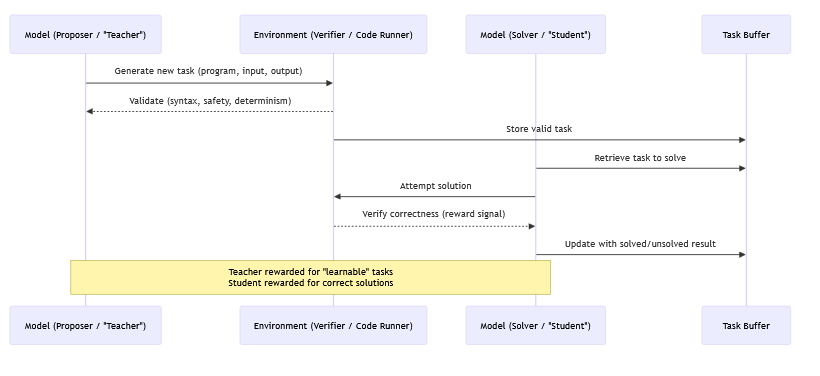
That’s where this paper’s idea, called Absolute Zero, comes in. Instead of relying on people to write problems, the model creates its own. One part of the model plays the “teacher,” proposing new tasks, and another part plays the “student,” trying to solve them. Because the environment is code, the answers can be automatically checked just by running the program—so no human needs to grade them.

The model learns three kinds of reasoning:

  • Deduction: given a program and input, figure out the output.
  • Abduction: given a program and an output, figure out the input.
  • Induction: given some examples, figure out the program that works in general.

The system rewards the student for solving problems correctly, and the teacher for coming up with problems that are just the right difficulty—not too easy, not impossible.

The result is that training only on these self-made coding tasks made the model better at math. On standard benchmarks, it matched or even beat other models that were trained with large sets of human-written problems. Bigger models improved even more, and “coder” models (already good at programming) saw the biggest gains. The model even started showing “scratch-pad” style reasoning on its own, writing little notes or plans before coding—without being told to.

In short, the key insight is this: you don’t necessarily need humans to write all the practice problems anymore. If you have a way to automatically check answers, a model can bootstrap itself, creating and solving its own challenges, and still learn to reason across domains.

The authors do warn that there are challenges—like making sure tasks stay diverse, keeping the system safe, and managing the heavy compute costs—but the big takeaway is that self-play with verifiable rewards could be a new path to building smarter, more independent reasoning systems.

There’s no “exam” in the usual sense for the students – the system builds a feedback loop between the teacher (proposer) and the student (solver).

Here’s how it works step by step:

1. Teacher proposes a task

The proposer (teacher model) generates a new program + input/output pair (a problem).

Example: “Write a function that finds prime numbers up to N.”

2. Environment checks validity

The environment (code runner) ensures the task is valid: it runs, is safe, deterministic, etc.

If valid, it gets stored in a task buffer.

3. Student attempts the task

The solver (student model) pulls the task and tries to solve it.

The environment executes the student’s answer and checks correctness.

4. Rewards reflect difficulty

If the student always solves a task → it’s too easy → proposer gets low reward.

If the student never solves a task → it’s too hard → proposer also gets low reward.

If the student solves it sometimes → it’s “learnable” → proposer gets high reward.

So the proposer doesn’t “know” in advance how good the student is. Instead, it learns over time:

Tasks that end up being useful for training (medium difficulty) get reinforced.

Tasks that are too trivial or impossible fade out because they bring no proposer reward.

The proposer is like a coach who experiments with new drills, and the student’s performance on them acts as the exam. Over time, the teacher learns what kinds of problems best stretch the student without breaking them.

RDMA, Infiniband, RoCE, CXL : High-Performance Networking Technologies for AI

As the demand for high-performance computing (HPC) and artificial intelligence (AI) continues to grow, networking technologies have become critical to ensuring the scalability and efficiency of modern data centers. Among these, RDMA, InfiniBand, RoCE, and the emerging CXL standard stand out as transformative technologies, each addressing unique challenges. Here’s a brief overview of these key technologies, trends, and future.

Remote Direct Memory Access (RDMA) was developed in response to the increasing need for low-latency, high-bandwidth data movement in distributed computing environments. RDMA was driven by a collaboration of major tech companies to address the limitations of traditional networking models. Some key players in RDMA’s early development include:

  • Compaq, IBM, and Intel:
    • Developed the initial RDMA architecture to improve networking efficiency, particularly in storage and high-performance computing.
  • Mellanox Technologies:
    • One of the first companies to commercialize RDMA with its InfiniBand solutions, allowing ultra-low latency communication.
  • Microsoft & Networking Industry:
    • Developed iWARP (RDMA over TCP/IP) to integrate RDMA into Ethernet-based networks.
  • InfiniBand Trade Association (IBTA):
    • Founded in 1999 by Compaq, Dell, Hewlett-Packard, IBM, Intel, Microsoft, and Sun Microsystems to standardize high-performance networking, including RDMA capabilities.

Before RDMA, networking relied on CPU-intensive packet processing, which created performance bottlenecks in data-intensive applications. The traditional TCP/IP stack required multiple CPU interrupts, context switches, and memory copies, leading to high latency and inefficiency.

RDMA Was Developed to Solve These Challenges:

  1. Eliminate CPU Bottlenecks:
    • Traditional networking required CPU cycles for data movement, slowing down high-speed applications.
    • RDMA bypasses the OS kernel and CPU, reducing overhead.
  2. Enable High-Speed, Low-Latency Communication:
    • Needed for HPC (High-Performance Computing), AI training, and databases.
    • Reduces communication latency to below 1 microsecond.
  3. Improve Scalability for Distributed Systems:
    • Large-scale data centers and supercomputers require fast inter-node communication.
    • RDMA enables efficient parallel computing across thousands of nodes.
  4. Optimize Storage and Networking:
    • Technologies like NVMe over Fabrics (NVMe-oF) use RDMA for ultra-fast storage access.
    • RDMA dramatically speeds up databases and cloud storage, reducing I/O latency.

Evolution and Implementations of RDMA

RDMA has evolved into different implementations, each suited for different networking environments:

RDMA VariantTransport ProtocolUse Case
InfiniBandNative InfiniBand transportHPC, AI training, supercomputing
RoCE (RDMA over Converged Ethernet)Ethernet (Layer 2/3)Cloud data centers, AI inference
iWARPTCP/IPEnterprise storage, cloud computing

RDMA’s Impact on Modern Computing

Today, RDMA is a core technology in AI, cloud computing, and high-speed storage. It enables:

  • Massive parallelism in AI training (e.g., NVIDIA DGX, GPT models).
  • Faster database transactions (e.g., Microsoft SQL Server, Oracle).
  • Low-latency cloud networking (used by Azure, AWS, Google Cloud).

InfiniBand: InfiniBand is a high-performance networking technology designed for low-latency, high-bandwidth communication. Primarily used in HPC and AI training clusters, InfiniBand supports features like Remote Direct Memory Access (RDMA), enabling direct memory-to-memory data transfers with minimal CPU involvement. Its scalable architecture makes it ideal for distributed workloads, offering latencies as low as 0.5 microseconds and bandwidths up to 400 Gbps (NDR).

RDMA over Converged Ethernet (RoCE): RoCE extends RDMA capabilities over Ethernet networks, bridging the gap between the performance of InfiniBand and the ubiquity of Ethernet. By leveraging standard Ethernet infrastructure with lossless configurations, RoCE delivers efficient communication for data centers that prioritize compatibility and cost. However, it typically exhibits slightly higher latencies (5-10 microseconds) compared to InfiniBand.

Compute Express Link (CXL): CXL is a new interconnect standard designed to provide low-latency, high-bandwidth communication between processors, accelerators, and memory devices within a single node. By leveraging PCIe infrastructure, CXL supports memory pooling, coherent data sharing, and dynamic resource allocation, addressing the growing complexity of heterogeneous compute environments

Key Technology Trends
  1. AI Training Driving High-Bandwidth Demand:
    • Training large-scale AI models requires massive data exchange between GPUs, CPUs, and memory. InfiniBand remains the leader in this domain due to its ultra-low latency and scalability, but RoCE is increasingly adopted in cost-sensitive deployments.
  2. Distributed Inference and Edge AI:
    • While inference typically has lower communication demands, distributed inference pipelines and edge AI are pushing for efficient interconnects. RoCE’s compatibility with Ethernet makes it a strong candidate in these scenarios.
  3. Memory-Centric Architectures:
    • With CXL’s focus on memory pooling and coherent memory sharing, the future of data centers may see significant convergence around flexible, node-level resource allocation. This complements, rather than competes with, network-level technologies like InfiniBand and RoCE.
  4. Interconnect Ecosystem Integration:
    • NVIDIA’s integration of InfiniBand with its GPUs and DPUs highlights the trend of tightly coupled compute and networking stacks. Similarly, innovations in RoCE and Ethernet SmartNICs are bringing RDMA capabilities closer to mainstream data centers.
Extrapolating to the future
  • Convergence of Standards: As workloads diversify, data centers may adopt hybrid approaches, combining InfiniBand for training clusters, RoCE for distributed inference, and CXL for intra-node memory coherence. Seamless interoperability between these standards will be ideal.
  • AI-Centric Network Evolution: The growing dominance of AI workloads will push networking technologies toward even lower latencies and higher bandwidths, with InfiniBand and RoCE leading the charge.
  • Rise of Heterogeneous Compute: CXL’s potential to unify memory access across CPUs, GPUs, and accelerators aligns with the industry’s shift toward heterogeneous compute, enabling efficient resource utilization and scalability.
  • Cloud-Driven Innovations: As hyperscalers like AWS, Google, and Azure integrate these technologies into their offerings, cost-efficient, scalable solutions like RoCE and CXL may become more widespread, complementing specialized InfiniBand deployments.

Direct Preference Optimization (DPO) vs RLHF/PPO (Reinforcement Learning with Human Feedback, Proximal Policy Optimization)

The paper “Direct Preference Optimization: Your Language Model is Secretly a Reward Model” introduces Direct Preference Optimization (DPO), an algorithm for fine-tuning language models to align with human preferences without the need for complex reinforcement learning procedures. This simplifies Reinforcement Learning with Human Feedback (RLHF) by not requiring a time consuming human feedback loop in training of the model.

Directly Modified Reward Function : DPO uses human preferences to directly modify the reward function, employing a classification loss to align the model outputs with these preferences. Rather than relying solely on reward signals from the environment, it leverages comparisons or preferences between different trajectories to guide the learning process. The agent is provided with pairs of trajectories along with a preference indicating which trajectory is preferred. This preference data is used to train the policy. The task of predicting preferences can be framed as a binary classification problem. For a given pair of trajectories the model needs to predict which path is preferred. The classification loss then measures the discrepancy between the predicted and actual preferences. A common choice for this kind of binary classification is the binary cross-entropy loss. The overall training objective in DPO involves minimizing the classification loss across all pairs of trajectories in the dataset, which encourages the policy to produce trajectories that align with the observed preferences.

RLHF and Proximal Policy Optimization: RLHF trains a reward model using PPO and data gathered on human preferences that is labeled by humans. These RLHF steps are shown in the diagram below, from the RLHF paper. PPO indirectly learns the reward function through interactions with the environment and optimizes the policy to maximize this reward, using a reinforcement learning framework. The policy here is a mapping from states to a probability distribution over actions.

So Direct Preference Optimization (DPO) modifies the reward function using human preference data. Here is a high-level overview of the equations used:

  1. Preference Model:
    • Let θ be the parameters of the model.
    • Let τ1​ and τ2​ be two trajectories (or outputs) being compared.
    • The preference model P(τ1≻τ2∣θ)  indicates the probability that humans prefer τ1​ over τ2​.
  2. Logistic Function for Preferences:
    • The preference probability is modeled using a logistic function:P(τ1≻τ2∣θ)=exp⁡(R(τ1∣θ)) / ( exp⁡(R(τ1∣θ)) + exp⁡(R(τ2∣θ)) )
    • R(τ∣θ) is the reward function for trajectory τ.
  3. Loss Function:
    • The loss function L(θ) is defined as the negative log-likelihood of the human preferences:L(θ)=−∑(τ1,τ2)∈D log⁡ P(τ1≻τ2∣θ)
    • D is the dataset of human preference comparisons.
  4. Optimization:
    • The model parameters θ are optimized by minimizing the loss function L(θ)

GPU kernel functions for deep learning

This article attempts to outline GPU Kernel Functions and how they are supported in TensorFlow, PyTorch, and OpenAI Triton. GPU Kernel Functions are specialized functions executed on an Nvidia Graphics Processing Unit. These functions play a key role in for parallel and accelerated computing such as tensor matrix operations used in deep learning.

GPU kernel functions for operations commonly used in deep learning include:

  1. Element-wise operations: TensorFlow provides GPU kernels for element-wise operations such as addition, subtraction, multiplication, and division, enabling efficient computation on arrays or tensors.
  2. Matrix operations: GPU kernels in TensorFlow optimize matrix operations like matrix multiplication, matrix addition, and matrix transpose, which are fundamental in many deep learning models.
  3. Convolutional operations: TensorFlow implements GPU kernels for convolutional operations, which are essential for tasks like image recognition and computer vision.
  4. Reduction operations: TensorFlow provides GPU kernels for reduction operations like summation, mean, maximum, and minimum, allowing efficient computation over large arrays or tensors.
  5. Activation functions: GPU kernels are implemented for common activation functions used in deep learning, such as ReLU (Rectified Linear Unit), sigmoid, and tanh.
  6. Pooling operations: TensorFlow’s GPU kernels optimize pooling operations like max pooling and average pooling, commonly used in convolutional neural networks (CNNs).
  7. Recurrent operations: TensorFlow provides GPU kernels for recurrent operations like LSTM (Long Short-Term Memory) and GRU (Gated Recurrent Unit), which are widely used in sequence-based models.

TensorFlow optimizes the execution of operations within a computation graph. When operations can be executed on a GPU, TensorFlow translates the high-level operations into CUDA calls that invoke the corresponding GPU kernels.

PyTorch is another popular open-source deep learning framework that provides a high-level programming interface for building and training machine learning models.

PyTorch differs from TensorFlow in a few ways:

  1. Dynamic Computational Graph: PyTorch uses a dynamic computational graph approach, whereas TensorFlow uses a static computational graph. This means that in PyTorch, the computational graph is constructed and executed on the fly as the code is executed, allowing for more flexibility and dynamic behavior during model training and inference.
  2. Imperative Programming: PyTorch follows an imperative programming style, which allows users to write code that is more intuitive and resembles standard Python programming. This makes it easier to understand and debug the code, as well as experiment with different model architectures and algorithms.
  3. Autograd: PyTorch’s autograd system allows automatic differentiation, which enables computing gradients for model parameters. This makes it easier to implement and train complex models, as users don’t have to manually compute gradients. TensorFlow, on the other hand, uses a static graph approach where gradients need to be explicitly defined and computed.
  4. TorchScript: PyTorch provides a feature called TorchScript, which allows models to be serialized and optimized for deployment in production environments. TorchScript enables efficient execution of PyTorch models on various platforms, including GPUs, CPUs, and mobile devices.

Like TensorFlow, PyTorch also implements GPU kernel functions for efficient computation on GPUs. It implements optimized GPU kernels similar to TensorFlow.

So while both TensorFlow and PyTorch provide GPU kernel function abstractions, their underlying computational graph models and programming styles differ, bringing their own unique advantages and trade-offs.

OpenAI Triton is a programming framework developed by OpenAI for building and deploying large-scale machine learning models efficiently. It leverages TensorFlow as its backend, supporting a wide range of models including deep learning and traditional algorithms. Triton offers tools for distributed computing, automated hyperparameter tuning, and model serving. It simplifies model deployment and management, making it suitable for both research and production environments. Triton abstracts away the need for users to write low-level GPU kernel functions by using TensorFlow’s optimized GPU operations implemented with CUDA, NVIDIA’s parallel computing platform. This approach allows developers to focus on defining high-level machine learning models without worrying about GPU optimization details.

It’s worth noting that Triton is built on top of TensorFlow, which supports alternative GPU acceleration libraries through backend integrations, and this enables Triton to leverage these alternatives to CUDA. One such alternative to CUDA is ROCm (Radeon Open Compute platform), developed by AMD. ROCm is an open-source GPU computing platform that provides support for AMD GPUs. TensorFlow has been working on integrating with ROCm, allowing it to utilize AMD GPUs for deep learning computations. As Triton relies on TensorFlow, it can benefit from this integration to support AMD GPUs through ROCm.

TorchScript for Model Optimization and Model Serving

TorchScript is an intermediate representation of a PyTorch model that can be optimized and run in a non-Python environment, making the PyTorch model suitable for deployment. It is part of the PyTorch ecosystem (Intro_to_TorchScript_tutorial.html , TorchScript JIT.html ).

Why is TorchScript needed ? Python while excellent for ML model development ( interpreted, REPL, simplicity, integration with number of ML libraries), also has characteristics that make it less suitable for model production deployments. These characteristics include interpretation overheads, complex dependency management, high memory/CPU overheads and the lack of easy integration with native technologies such as C++ for high performance and for embedded systems. TorchScript provides tools for optimizations such as operator fusion and static graph analysis which can improve the efficiency and performance during inference. Optimizing the models is crucial for embedded systems with limited resources.

PyTorch had introduced eager/dynamic execution, which had the advantage of faster user feedback but the disadvantage of not having as many optimizations as were possible in static approaches as in Tensorflow.

A blog on Key points to grasp about TorchScript – https://medium.com/@hihuaweizhu/key-points-to-grasp-for-torchscript-beginners-c02cf94aaa50, makes several good points, including that TorchScript is a subset of PyTorch and consists of statically typed variables.

A discussion between eager mode and script mode at https://towardsdatascience.com/pytorch-jit-and-torchscript-c2a77bac0fff suggests the benefit of TorchScript is more about dev/production (versus training/inference), with the production version requiring performance optimizations and portability. Quote: “With TorchScript, PyTorch aims to create a unified framework from research to production. TorchScript will take your PyTorch modules as input and convert them into a production-friendly format.

NVIDIA uses TorchScript to facilitate the deployment and optimization of PyTorch models within their ecosystem. The Torchscript models are compiled to TensorRT, the Nvidia runtime .

AWS ML software stack, Neuron, supports tracing in torchscript. https://awsdocs-neuron.readthedocs-hosted.com/en/latest/frameworks/torch/torch-neuronx/api-reference-guide/inference/api-torch-neuronx-trace.html . https://pytorch.org/docs/master/generated/torch.jit.trace.html#torch.jit.trace . An example of a neuron sdk trace for pytorch – https://github.com/aws-neuron/aws-neuron-sdk/issues/371 .

PyTorch/XLA is another project that integrates with Google XLA compiler to enable running PyTorch models on Google TPUs.

GraphCore produces hardware for deep learning called a GraphCore Intelligence Processing Unit (IPU). The primary software framework provided by GraphCore to execute machine learning models on their IPUs is Poplar. It allows running models from TensorFlow and PyTorch. Poplar optimizes computations for the unique architecture of GraphCore’s IPUs. This includes optimizations for memory bandwidth, parallel processing, and other hardware-specific features.

Deep Reinforcement Learning key papers

Reinforcement Learning (RL) combined with Deep Learning has been termed Deep Reinforcement Learning (DRL). Deep learning provides function approximation techniques that can handle large and complex state and/or action spaces, making it possible to tackle problems that were infeasible with traditional RL techniques. This line of research led to transformers and LLMs. Here’s a brief timeline of key insights and breakthroughs in Deep Reinforcement Learning over the past decade:

1. 2013Playing Atari with Deep Reinforcement Learning:
  • Organization: DeepMind
  • Breakthrough: This was perhaps the first major work that combined deep learning with Q-learning, resulting in a Deep Q-Network (DQN). The DQN was able to play several Atari 2600 games at or above human-level performance.
  • Key Insights: Experience replay and fixed Q-targets were used to stabilize learning. The experience replay helped in breaking the temporal correlations, and fixed Q-targets reduced the moving target problem in Q-learning.
2. 2015Human-level control through deep reinforcement learning:
  • Organization: DeepMind
  • Breakthrough: An extension of the 2013 DQN work, this presented a more robust DQN that achieved human-level performance across a broad range of Atari games.
  • Key Insights: Further stabilization and scaling of DQNs.
3. 2015Continuous control with deep reinforcement learning (DDPG):
  • Organization: DeepMind
  • Breakthrough: Introduced the Deep Deterministic Policy Gradient (DDPG) algorithm for continuous action spaces.
  • Key Insights: It utilized actor-critic architecture where the actor produces a deterministic policy, and the critic evaluates it. The Ornstein-Uhlenbeck process was used to add exploration noise.
4. 2016Asynchronous Methods for Deep Reinforcement Learning (A3C):
  • Organization: DeepMind
  • Breakthrough: Introduced the Asynchronous Advantage Actor-Critic (A3C) algorithm which combined the actor-critic approach with asynchronous updates.
  • Key Insights: Multiple agents, each with its own set of model parameters, explored different parts of the environment simultaneously, leading to faster and more robust policy learning. The asynchronous nature also helped in stabilizing learning.
5. 2017Proximal Policy Optimization (PPO):
  • Organization: OpenAI
  • Breakthrough: Introduced a simpler and more robust method for policy gradient optimization, making training more stable.
  • Key Insights: PPO constrains the policy updates to ensure the new policy isn’t too different from the old policy, thereby avoiding extreme policy updates that can destabilize training. PPO balances the benefits of both Policy Gradient methods (link) and Trust Region Policy Optimization methods (TRPO link). PPO achieves this by using a clipped surrogate objective that prevents large updates during training, enhancing stability and performance. In the context ofPPO, the term “surrogate objective” refers to an approximation used in place of the actual objective function during optimization. This surrogate function is easier to optimize and ensures more stable and reliable updates to the policy. The clip function ensures that the probability ratiodoes not deviate too far from 1 by clipping it to the range [1−ϵ,1+ϵ][1−ϵ,1+ϵ]. This prevents excessively large policy updates.
6. 2018Soft Actor-Critic (SAC):
  • Organization: UC Berkeley
  • Breakthrough: SAC is an off-policy actor-critic deep RL algorithm based on the maximum entropy RL framework.
  • Key Insights: SAC seeks policies that maximize both expected return and entropy, leading to more exploration, smoother policy updates, and generally better performance on continuous control tasks.
7. 2019 and beyond:

Subsequent years have seen the evolution of these methods and the introduction of new algorithms, improvements in sample efficiency, stability, and scalability. Also, there has been a focus on:

  • Transfer Learning: Using pre-trained models to improve sample efficiency in RL.
  • Meta-learning: Training agents that can quickly adapt to new tasks.
  • Model-based RL: Incorporating learned models of the environment dynamics to improve sample efficiency and policy learning.

Accuracy vs Recall vs Precision vs F1 in Machine Learning

We want to walk through some common metrics in classification problems – such as accuracy, precision and recall – to get a feel for when to use which metric. Say we are looking for a needle in a haystack. There are very few needles in a large haystack full of straws. An automated machine is sifting through the objects in the haystack and predicting for each object whether it is a straw or a needle. A reasonable predictor will predict a small number of objects as needles and a large number as straws. A prediction has two attributes – positive/negative and accurate/inaccurate.

Positive Prediction: the object at hand is predicted to be the needle. A small number.

Negative Prediction: the object at hand is predicted not to be a needle. A large number.

True_Positive: of the total number of predictions, the number of predictions that were positive and correct. Correctly predicted Positives (needles). A small number.

True_Negative: of the total number of predictions, the number of predictions that were negative and correct. Correctly predicted Negatives (straws). A large number.

False_Positive: of the total number of predictions, the number of predictions that are positive but the prediction is incorrect. Incorrectly predicted Positives (straw predicted as needle). Could be large as the number of straws is large, but assuming the total number of predicted needles is small, this is less than or equal to predicted needles, hence small.

False_Negative: of the total number of predictions, the number of predictions that are negative but the prediction is incorrect. Incorrectly predicted Negatives (needle predicted as straw). Is this a large number ? It is unknown – this class is not large just because the class of negatives is large – it depends on the predictor and a “reasonable” predictor which predicts most objects as straws, could also predict many needles as straws. This is less than or equal to the total number of needles, hence small.

Predicted_Positives = True_Positives + False_Positives = Total number of objects predicted as needles.

Actual Positives = Actual number of needles, which is independant of the number of predictions either way, however Actual Positives = True Positives + False Negatives.

Accuracy = nCorrect _Predictons/nTotal_Predictions=(nTrue_Positives+nTrue_Negatives) / (nPredicted_Positives +nPredicted_Negatives) .   # the reasonable assumption above is equivalent to a high accuracy. Most predictions will be hay, and be correct in this simply because of the skewed distribution. This does not shed light on FP or FN.

Precision = nTrue_Positives / nPredicted_Positives    # correctly_identified_needles/predicted_needles;  this sheds light on FP; Precision = 1 => FP=0 => all predictions of needles are in fact needles; a precision less than 1 means we got a bunch of hay with the needles – gives hope that with further sifting the hay can be removed.  Precision is also called Specificity and quantifies the absence of False Positives or incorrect diagnoses.

Recall = nTrue_Positives / nActual_Positives  = TP/(TP+FN)# correctly_identified_needles/all_needles; this sheds light on FN; Recall = 1 => FN = 0; a recall less than 1 is awful as some needles are left out in the sifting process. Recall is also called Sensitivity .

Precision > Recall => FN is higher than FP

Precision < Recall => FN is lower than FP

If at least one needle is correctly identified as a needle, both precision and recall will be positive; if zero needles are correctly identified, both precision and recall are zero.

F1 Score is the harmonic mean of Precision and Recall.  1/F1 = 1/2(1/P + 1/R) . F1=2PR/(P+R) .  F1=0 if P=0 or R=0. F1=1 if P=1 and R=1.

ROC/AUC rely on Recall (=TP/TP+FN) and another metric False Positive Rate defined as FP/(FP+TN)  = hay_falsely_identified_as_needles/total_hay . As TN >> FP, this should be close to zero and does not appear to be a useful metric in the context of needles in a haystack; as are ROC/AuC . The denominators are different in Recall and FPR, total needles and total hay respectively.

There’s a bit of semantic confusion when saying True Positive or False Positive. These shorthands can be interpreted as- it was known that an instance was a Positive and a label of True or False was applied to that instance. But what we mean is that it was not known whether the instance was a Positive, and that a determination was made that it was a Positive and this determination was later found to be correct (True) or incorrect (False). Mentally replace True/False with ‘Correct/Incorrectly identified as’ to remove this confusion.

Normalization: scale of 0-1, or unit norm; useful for dot products when calculating similarity.

Standardization: zero mean, divided by standard deviation; useful in neural network/classifier inputs

Regularization: used to reduce sensitivity to certain features. Uses regression. L1: Lasso regression L2: Ridge regression

Confusion matrix: holds number of predicted values vs known truth. Square matrix with size n equal to number of categories.

Bias, Variance and their tradeoff. we want both to be low. When going from a simple model to a complex one, one often goes from high bias to a high variance scenario. https://towardsdatascience.com/understanding-the-bias-variance-tradeoff-165e6942b229