Category: auth

RSA World 2020 – QRNG based crypto keys

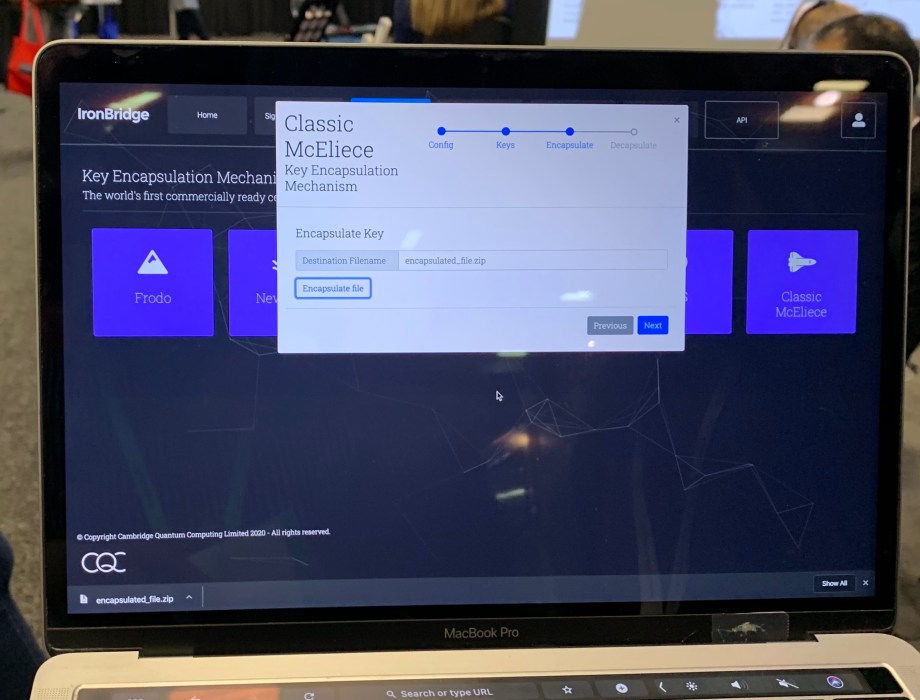
Creating my first Quantum Crypto keys. The QC hardware provides the entropy source for generation of a key, which is encapsulated using one of several available mechanisms. Key encapsulation mechanism chosen is was Classic McEliece. Keys were emailed to me after generation at the Cambridge Quantum Computing booth at RSA World 2020.

Quantum-Proof Cryptography with IronBridge, TKET and Amazon Braket

Cambridge Quantum Computing has developed the first provable QRNG, known as IronBridge, which uses quantum computers to generate unbiased private entropy. IronBridge generates cryptographic keys using this entropy, resulting in quantum-proof keys (for both classical and post-quantum algorithms).

Their paper on “Practical randomness and privacy amplification” – https://arxiv.org/pdf/2009.06551.pdf

Links on McEliece, Goppa codes, FrodoKEM and PQC –

https://en.wikipedia.org/wiki/McEliece_cryptosystem

https://en.wikipedia.org/wiki/Binary_Goppa_code

FrodoKEM: https://eprint.iacr.org/2018/686.pdf : In 2016, Bos et al. proposed the key exchange scheme FrodoCCS, that is also a submission to the NIST post-quantum standardization process, modified as a key encapsulation mechanism (FrodoKEM). The security of the scheme is based on standard lattices
and the learning with errors problem

PQ Crypto Catalog: https://github.com/kriskwiatkowski/pqc  has implementations of quantum-safe signature and KEM schemes submitted to NIST PQC standardization process

Firecracker MicroVM Security

I wanted to get a better understanding of firecracker microVM security, from the bottom up. A few questions –

a) how does firecracker design achieve a smaller threat surface than a typical vm/container ?

b) what mechanisms are available to secure code running in a microvm ?

c) and lastly, how can microvms change security considerations when deploying code for web services ?

The following design elements contribute to a smaller threat surface:

  • minimal design, in a memory safe, compact, readable rust language
  • minimal guest virtual device model: a network device, a block I/O device, a timer, a  KVM clock, a serial console, and a partial keyboard
  • minimal networking; from docs/vsock.md : “The Firecracker vsock device aims to provide full virtio-vsock support to software running inside the guest VM, while bypassing vhost kernel code on the host. To that end, Firecracker implements the virtio-vsock device model, and mediates communication between AF_UNIX sockets (on the host end) and AF_VSOCK sockets (on the guest end).”
  • static linking of the firecracker process limits dependancies
  • seccomp BPF limits the system calls to 35 allowed calls, 30 with simple filtering, 5 with advanced filtering that limits the call based on parameters (SeccompFilter::new call in vmm/src/default_syscalls/filters.rs, seccomp/src/lib.rs)

The production security setup recommends using jailer to apply isolation based on cgroups, namespaces, seccomp. These techniques are typical of container isolation and act in addition to KVM based isolation.

The Firecracker Host Security Configuration recommends a series of checks to mitigate side-channel issues for a multi-tenant system:

  • Disable Simultaneous Multithreading (SMT)
  • Check Kernel Page-Table Isolation (KPTI) support
  • Disable Kernel Same-page Merging (KSM)
  • Check for speculative branch prediction issue mitigation
  • Apply L1 Terminal Fault (L1TF) mitigation
  • Apply Speculative Store Bypass (SSBD) mitigation
  • Use memory with Rowhammer mitigation support
  • Disable swapping to disk or enable secure swap

How is the firecracker process organized ? The docs/design.md has the following descriptions:

Internal Design: Each Firecracker process encapsulates one and only one microVM. The process runs the following threads: API, VMM and vCPU(s). The API thread is responsible for Firecracker’s API server and associated control plane. It’s never in the fast path of the virtual machine. The VMM thread exposes the machine model, minimal legacy device model, microVM metadata service (MMDS) and VirtIO device emulated Net and Block devices, complete with I/O rate limiting. In addition to them, there are one or more vCPU threads (one per guest CPU core). They are created via KVM and run the `KVM_RUN` main loop. They execute synchronous I/O and memory-mapped I/O operations on devices models. 

Threat Containment: From a security perspective, all vCPU threads are considered to be running malicious code as soon as they have been started; these malicious threads need to be contained. Containment is achieved by nesting several trust zones which increment from least trusted or least safe (guest vCPU threads) to most trusted or safest (host). These trusted zones are separated by barriers that enforce aspects of Firecracker security. For example, all outbound network traffic data is copied by the Firecracker I/O thread from the emulated network interface to the backing host TAP device, and I/O rate limiting is applied at this point.

What about mechanisms to secure the code running inside firecracker ? The serverless environment, AWS Lambda, and its security best practices are a place to start. Resources on these are here, here, here and here. AWS API gateway supports input validation, as described here.  While serverless reduces the attack surface, the web threats such as OWASP still apply and must be taken into account during design and testing.

For the last question – uVMs and serverless appear to offer a promising model to build a service incrementally from small secure building blocks – and this is something to explore further.

FaceID vs TouchID on iPhone, and FIDO on Android

As a developer Apple made it the transition from TouchId to FaceId easy with the LocalAuthentication library (more below). But as a user that had grown accustomed to TouchId, I did not like the TouchId button going away. What were the reasons for TouchId to be replaced completely by FaceId. What happened on other platforms like Android and FIDO ? Let’s explore in this post.

Both Touch ID and Face ID are biometric authentication technologies developed by Apple for their iPhone lineup. Each has distinct implementations and security features. Here’s a detailed contrast of the security aspects and implementations of Touch ID and Face ID:

Touch ID

Implementation:

  • Technology: Touch ID uses a capacitive touch sensor embedded in the Home button or, in newer models, in the power button.
  • Enrollment: Users register their fingerprint by repeatedly placing their finger on the sensor, which captures a high-resolution image of the fingerprint.
  • Authentication: When authenticating, the sensor captures the fingerprint image and compares it to the enrolled fingerprint data.

Security Features:

  • Secure Enclave: Fingerprint data is stored in an encrypted format in the Secure Enclave, a separate processor within the iPhone’s A-series chip. This ensures that fingerprint data is never accessible to the operating system or any apps.
  • False Acceptance Rate (FAR): Apple claims that the chance of a random person being able to unlock an iPhone with Touch ID is approximately 1 in 50,000.
  • Liveness Detection: Touch ID includes some measures to detect the presence of a live finger to prevent spoofing with artificial fingerprints.

Face ID

Implementation:

  • Technology: Face ID uses a combination of infrared and dot projection technology, known as the TrueDepth camera system, to create a detailed 3D map of the user’s face.
  • Enrollment: Users enroll by moving their head around so that the TrueDepth camera can capture their face from multiple angles.
  • Authentication: During authentication, the system projects over 30,000 infrared dots onto the user’s face and captures the pattern with an infrared camera to create a 3D facial map.

Security Features:

  • Secure Enclave: Facial data is also stored in the Secure Enclave in an encrypted format, similar to Touch ID, ensuring it is never accessible to the operating system or apps.
  • False Acceptance Rate (FAR): Apple claims that the probability of a random person unlocking an iPhone with Face ID is approximately 1 in 1,000,000.
  • Liveness Detection: Face ID employs advanced liveness detection to ensure the person presenting the face is real and not a photo or mask. This includes attention awareness, requiring the user’s eyes to be open and looking at the device.
  • Adaptability: Face ID can adapt to changes in the user’s appearance over time, such as growing facial hair, wearing glasses, or aging.

Comparison and Security Implications

  • Accuracy and False Acceptance Rate: Face ID is significantly more accurate than Touch ID, with a FAR of 1 in 1,000,000 compared to Touch ID’s 1 in 50,000. This means Face ID is generally more secure against random attempts to unlock the device.
  • Resistance to Spoofing: Both systems are designed to resist spoofing, but Face ID’s use of 3D facial mapping and infrared technology makes it more robust against attempts to bypass it using photos or masks. Touch ID’s liveness detection is less sophisticated compared to Face ID.
  • Environmental Conditions: Touch ID can be affected by wet or dirty fingers and may not work if the sensor is damaged. Face ID, on the other hand, can be impacted by certain lighting conditions or if the user is wearing accessories that obscure the face (e.g., certain sunglasses or masks).
  • User Convenience: Face ID generally offers a more seamless experience as it works even when the user’s hands are occupied or when wearing gloves. However, in situations where face coverings are required, Touch ID may be more convenient.

Both Touch ID and Face ID offer robust security features, but Face ID provides enhanced security through its more sophisticated technology and lower false acceptance rate. The choice between the two may come down to personal preference and specific use cases, such as the need for convenience in different environments.

Transition from Touch ID to Face ID

API Transition:

  1. Initial Introduction:
  • Touch ID (iOS 7, 2013): When Apple introduced Touch ID with the iPhone 5s, they provided APIs in the LocalAuthentication framework, allowing developers to integrate fingerprint authentication into their apps.
  • Face ID (iOS 11, 2017): With the introduction of Face ID in the iPhone X, Apple updated the LocalAuthentication framework to support facial recognition alongside fingerprint recognition.
  1. Unified API:
  • Apple designed the LocalAuthentication framework to abstract away the specifics of biometric authentication. This means developers typically don’t need to change their code to support both Touch ID and Face ID. Instead, they use general methods to request biometric authentication, and the system handles the specifics.
  • For example, the method LAContext.evaluatePolicy(_:localizedReason:reply:) works for both Touch ID and Face ID.
  1. Backward Compatibility:
  • Apple ensured backward compatibility, so apps built to support Touch ID automatically support Face ID without requiring significant changes. The system dynamically determines which biometric method to use based on the hardware capabilities of the device.

Developer Considerations:

  • Developers are encouraged to check for biometric type (LABiometryType) to provide appropriate messaging or handle specific cases where one type may be preferred.
  • Apple provides clear guidelines and updates during WWDC (Apple Worldwide Developers Conference) to help developers transition smoothly and take full advantage of new hardware features.

FIDO on Android

FIDO (Fast Identity Online):

  1. Overview:
  • The FIDO Alliance is an open industry association aimed at creating authentication standards to reduce reliance on passwords. FIDO protocols use standard public key cryptography techniques to provide stronger authentication.
  1. Adoption on Android:
  • Android has supported FIDO2 since Android 7.0 (Nougat). FIDO2 includes WebAuthn (web authentication API) and CTAP (Client to Authenticator Protocol), enabling passwordless authentication on the web and mobile apps.
  • Google Play Services provide FIDO2 API support, making it available on most modern Android devices.
  1. Biometric Integration:
  • Android’s BiometricPrompt API (introduced in Android 9.0 Pie) allows apps to integrate various types of biometric authentication (fingerprint, face, iris) in a standardized way.
  • BiometricPrompt is designed to support multiple biometric types, providing a unified API similar to Apple’s LocalAuthentication framework.

Face ID on Android:

  1. Face Authentication:
  • Android supports face authentication through the BiometricPrompt API. The specifics of face authentication can vary by manufacturer, as Android devices have diverse hardware capabilities.
  • Devices like Google Pixel 4 and some Samsung models have advanced face recognition similar to Apple’s Face ID, using infrared sensors and dot projection for 3D facial mapping.
  1. FIDO and Biometric Standards:
  • The FIDO Alliance promotes biometric standards, including facial recognition, but the implementation and quality can vary widely on Android devices.
  • Some Android manufacturers implement their own facial recognition solutions, while others rely on Google’s BiometricPrompt API for a more standardized approach.

Transition from Touch ID to Face ID:

  • Apple’s transition from Touch ID to Face ID was facilitated by a unified API (LocalAuthentication), allowing seamless integration for developers and users.

FIDO on Android:

  • FIDO2 standards are widely supported on Android, enabling strong, passwordless authentication.
  • Android supports multiple biometric methods, including facial recognition, through the BiometricPrompt API. However, the implementation quality and technology can vary between devices.

Zero Trust Networks

Instead of  the “inside” and “outside” notion of traditional firewalls and perimeter defense technologies, the Zero Trust Network notion has its origin in the Cloud+Mobile first world where a person carrying a mobile device can be anywhere in the world (inside/outside the enterprise) and needs to be seamlessly and securely connected to online services.

The essential idea appears to be device authentication coupled with a second factor in the shape of an easy to remember password, with backend security smarts to identify the accessing device. More importantly, every service that is access externally needs to be authenticated, instead of some services being treated as internal services and being less protected.

Some properties of zero trust networks:

  • Network locality based access control is insufficient
  • Every device, user and service is authenticated
  • Policies are dynamic – they gather and utilize data inputs for making access control decisions
  • Attacks from trusted insiders are mitigated against

This is a big change from many networks which have network based defense at the core (for good reason, as it was cost effective). To create a zero-trust network, a startin point is to identify, enumerate and sequence all network flows.

I attended a talk by Centrify on this topic, which resonated with experiences in cloud, mobile and fog systems.

Related effort in Kubernetes – Progress Toward Zero Trust Kubernetes Networks, Istio Service Mesh , API Gateway to Service Mesh.  One can contrast the API gateway as being present only at the ingress point of a cloud, whereas with a Zero-trust/Service-mesh/Sidecar approach every microservice building-block has its own external proxy and ‘API’ for management added to it. The latter would add to latency concerns for real-time applications, as the new sidecar proxies are in the data path. One benefit of the service mesh is a mechanism to put in service to service security in a uniform manner.

The key original motivation behind Istio, in the second presentation by Lyft above, was greater observability and reliability across a complex cluster of microservices. This strikes me as a greater motivating use-case of this technology, than added security.  From the security point of view, there is a parallel of the Istio approach with the SDN problem statement of a horizontal and ubiquitous security layer.   Greater visibility is also a motivation behind the P4 programming language presented in disaggregated storage talk on protocol independant switch architecture or PISA here – one of the things it enables is inband telemetry.

SCRAM: Salted Challenge Response Authentication Mechanism

SCRAM is an interesting proposal (RFC-5802) that aims to remove passwords being commonly sent across the wire. It does not appear to create additional requirements for certificates or shared secrets, so let’s see how it works.

The server is required to know the username in advance, but not the password, instead a hash of the password and a (per-user) salt and an iteration count which is used to create a challenge.

The client sends the username and a nonce. The server retrieves the salt and updates the iteration count and sends these back to the client as a challenge. The client hashes the password with the agreed upon hash function, and uses the salt and the iteration count in the calculation, and send it back to the server. The server is able to validate correctness of the hashed password with the information it has.  The server then sends back a hash which the client can check to validate the server.

There are several issues with it – the initial registration flow is left out, the requirements of the client and server to issue good nonces and maintain unique salts and iterations are high, and also the requirement for the server database itself to be secure – an exfiltration could enable brute force attacks.  Then it uses SHA-1 which is weak. The password is fixed and an update method would need to be designed for a full system.

Still it is interesting as a way to remove passwords being sent over the wire.

The protocol is used in XMPP as a standard mechanism for authentication.


One Time Passwords for Authentication

A MAC or Message Authentication Code protects the integrity and authenticity of a message by allowing verifiers to detect changes to the message content. It requires a random key generation algo that produces a per-message random key K, a signing algorithm which takes K and message M as input and produces signature S, and a verifying algorithm with takes K,  M and S as input and produces a binary decision to accept or reject the message. Unlike a digital signature a MAC typically does not provide non-repudiation. It is also called a protected checksum. Both sender and recipient of the K and M share a secret key.

HMAC: So called Hashed-MAC because it uses a cryptographic hash function, such as MD/SHA to create a MAC. The computed value is something only someone with the secret key can compute (sign) and check (verify). HMAC uses an inner key and an outer key to protect against length extension and collision attacks on simple MAC signature implementations. RFC 2104. It is a type of Nested MAC (NMAC) where both inner and outer keys are derived from the same key, in a way that keeps the derived keys independent.

HOTP: HMAC-based One Time Password.   HOTP is based on an incrementing counter. The incrementing counter serves as the message M, and when run through the HMAC it produces a random set of bytes, which can be verified by the receiving party. The receiving party keeps a synchronized counter, so the message M=C does not need to be send on the wire. RFC 4226.

TOTP: Time-based One-time Password Algorithm . TOTP combines a secret key with the current timestamp using a cryptographic hash function to generate a one-time password. Because network latency and out-of-sync clocks can result in the password recipient having to try a range of possible times to authenticate against, the timestamp typically increases in 30-second intervals. Here the requirement to keep the counter synchronized is replaced with time synchronization. RFC 6328.


Erlang ‘for’ and ‘if’

When thinking of immutable state, I imagine a large

input->[processingbox]->output

box being broken into a chain of multiple smaller mini-boxes,

input0->[pbox0]->output0 -> [pbox1]->output1 ->[pbox2]->output3

with each individual box accomplishing a change in its input to its output, without keeping any internal mutable state.

Which reminds me of Linear-Time-Invariant systems. As long as each part of the system is linear and time-invariant, a large system can be composed of simpler parts and still be analyzed by deriving a composite transfer function. The composite system can be studied for its stability and loss/gain characteristics and adjustments made in the system design.

I suspect a similar payoff occurs with functional programming. But it is not so clearly stated or visible in the ability to analyze large programs. Erlang is essentially a version of event driven programming. The conciseness of expression is encouraging, but I hope to arrive at good examples of program composition.

Meanwhile the ‘if’ statement in erlang is a curveball. In addition to the odd syntax, and statements like true->false, one finds one cannot place a log statement anywhere inside a set of statements to see what’s going on. Punctuation rules. The trick is to place the log a comma before the last expression before the semicolon.

if
   Val >= Left andalso Val =< Right ->
   io:format("==> ok~p<~p<~p\n\n",[Left,Val,Right]),
   true;

   true ->
   io:format("==>not ok ~p<~p<~p\n\n",[Left,Val,Right]),
   false
end.

The semicolons indicate different phrases which are pattern-matching options. The commas are continued statements within the same phrase. The last statement in the phrase is the return value. The last phrase is typically a catch-all, in this case returning a value of false. The case statement is more commonly used than the if. The -> denotes  ‘lhs condition is mapped to rhs’ .

The ‘for’ statement does not exist at all and below are alternatives.

foreach(Fun, List)->ok, %% just applies a function Fun to each element of a list
foldl(Fun, Accumulator, List)-> Acc1,  %% fold list left to right into an accumulator
foldl(Fun, Accumulator, List)-> Acc1 %% fold list right to left into an accumulator
map(Fun, List1) -> List2  %% maps a list to a new list

The = sign in erlang is used for (a) immutable assignment of a term to a value and (b) for comparing if a previously assigned term or expression of terms is the same as another term or value – this is called pattern matching. One cannot reassign a term to a new value, so the math notion of equality always holds. The = used in C/Java could be called mutable assignment, every variable is hiding within it mutable state. A term in erlang does have an internal state of bound or unbound. On a successful pattern match any unbound variable becomes bound.

1> [H|T] = [1,2,3].

2> io:write(H) .

To generate a list of numbers, like range(n) in python, there is lists:seq(1,n). io:fwrite(“~p”, [lists:seq(1,20)]).

The philosophy behind some of these decisions is discussed here https://news.ycombinator.com/item?id=13499377. An objective is to make it impossible to write runaway loops – to make the runtime system always be able to recover and reallocate its cycles. A related aspect is to let-it-fail and not write a lot of exception handling, defensive code.

My erlang work was done while modifying RabbitMQ (written in erlang) to support features for certificate based authentication for MQTT, while consulting at GE Predix.

Erlang OTP (for Open Telecom Platform) is a layer on top of erlang language and proposes design principles for organizing code including ideas around failure handling with supervision trees. These form the basis of the actor model, where code is structured as isolated processes that communicate by sending and receiving messages. The actor can crash but is supervised by another actor. More in https://www.brianstorti.com/the-actor-model/ .

Tail recursion in erlang with an accumulator, is used as a replacement for loops – https://learnyousomeerlang.com/recursion

‘Tail recursion is a way to transform a linear process (it grows as much as there are elements) to an iterative one (there is not really any growth).’

Whatsapp talk on Engineering for Scale mentions Erlang allows hot-swapping and loose coupling because of message queues everywhere, and after fixing a bug looking for places where contagion spread, meaning there was not enough loose coupling there – https://developers.facebook.com/videos/f8-2016/a-look-at-whatsapp-engineering-for-success-at-scale
SSO, SAML, OAuth, JWT, OpenID

Web authentication and SSO typically imply that state is maintained on the server to indicate whether the user is logged in or not. The identity provider maintains this state and the identity consumers check this state with the identity provider. The protocol and message format differ in different implementations – SAML, OAuth, OpenID and several others.

SAML is the richest, most flexible auth protocol, but also most complex to implement. It covers the most number of use cases. The security assertions about an identity are captured in an xml format which can be exchanged between providers and consumers over the web.

OAuth is simpler and requires fewer things from the implementer. OAuth 2 has become a vehicle for enterprise use cases like SAML. SDKs for OAuth are available.

OAuth 2 and OpenID both use Json WebToken (JWT) which is a JSON format specification for interoperability.

OpenID Connect is the most open and newest of the three. It reduces  reliance on checking auth state with the identity provider by embedding more information in the JWT and standardizing things like scope to increase interoperability. If officially supports authentication use cases, unlike OAuth2 which is designed for authorization, but is used for pseudo-authentication.

A key consideration when deciding on an implementation is the scalability requirement. Ideally the system is structured to keep the least amount of state (zero) on the server. This is not true of most SSO implementations.

Like a stateless NFS server, based on leases for lock state that can be refreshed, a stateless implementation for SSO is possible (classic NFS has no open, only lookup). The tradeoff is that revocation is not as easy and reporting may need to be handled differently than with a stateful implementation. Here’s a discussion – http://stackoverflow.com/questions/26739167/jwt-json-web-token-automatic-prolongation-of-expiration

Update. Here’s another discussion which points to some tradeoffs – https://developer.okta.com/blog/2017/08/17/why-jwts-suck-as-session-tokens , basically that this is more useful for SSO and API implementations not simple websites.

iOS TouchID Enterprise Use Cases

When implementing TouchID for an enterprise authentication solution there are some interesting attack vectors to consider, that are not obvious.

There are differences in requirements between COPE and BYOD deployments for instance.

Depending on the type of deployment and the type of data accessed, the security required may call for (a) a simple TouchId based “user presence check”,  without a password being stored or retrieved, or (b) for a password to be stored in the enclave to be retrieved, or (c) for TouchId to be combined with another factor for a multi-factor authentication solution.

Some drawbacks to the initial TouchID implementation for enterprise uses cases, were discussed here . There is now a developer API available which allows more flexibility in implementing a solution for the enterprise.